Ice Hotels
Four winter buildings that share one problem. Snow, lake ice and river ice are seasonal ground: they arrive, carry a building for a few months, and go. Two of these places rebuild every year on a surface that has to form first. Two stand on permanent footings beside the ice and only borrow the view of it.
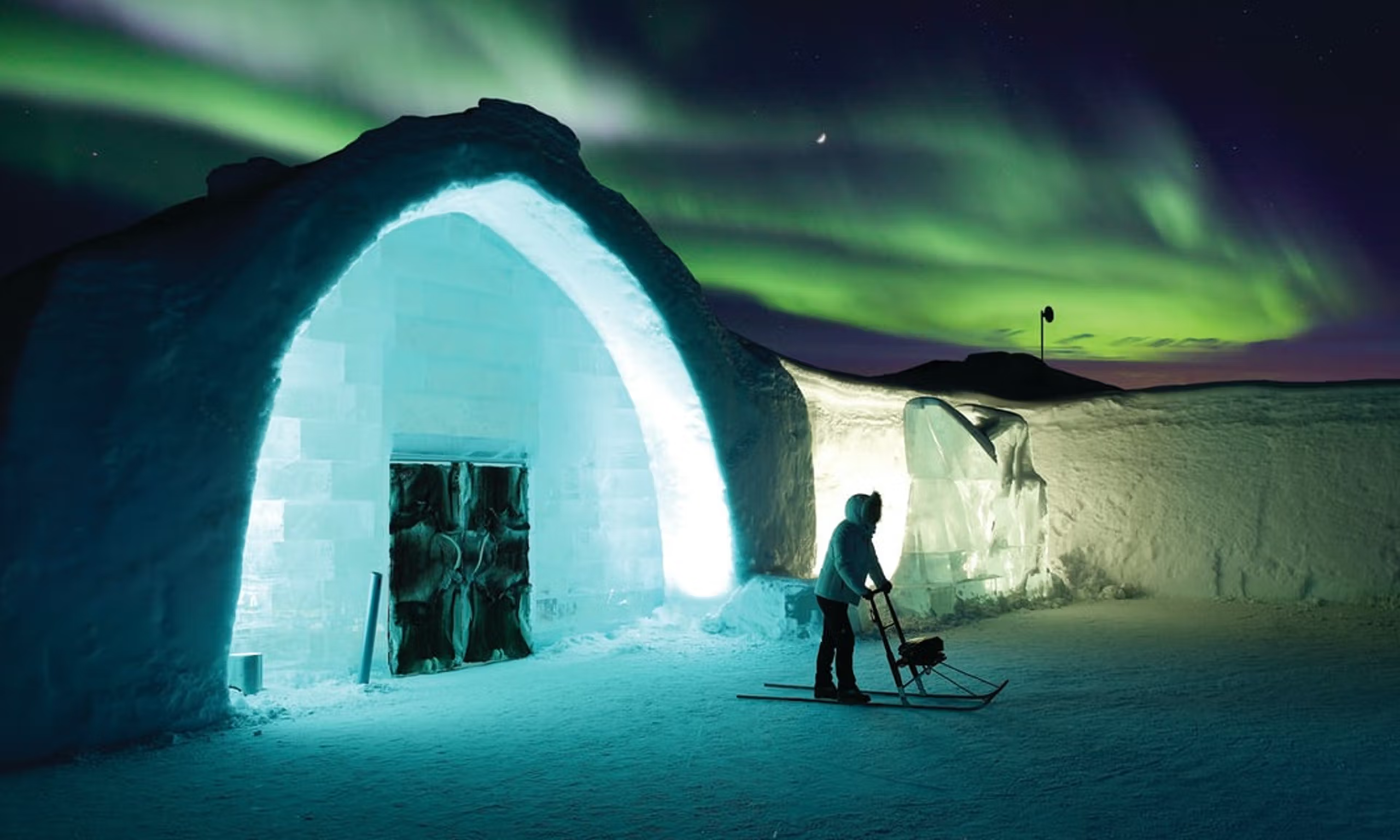
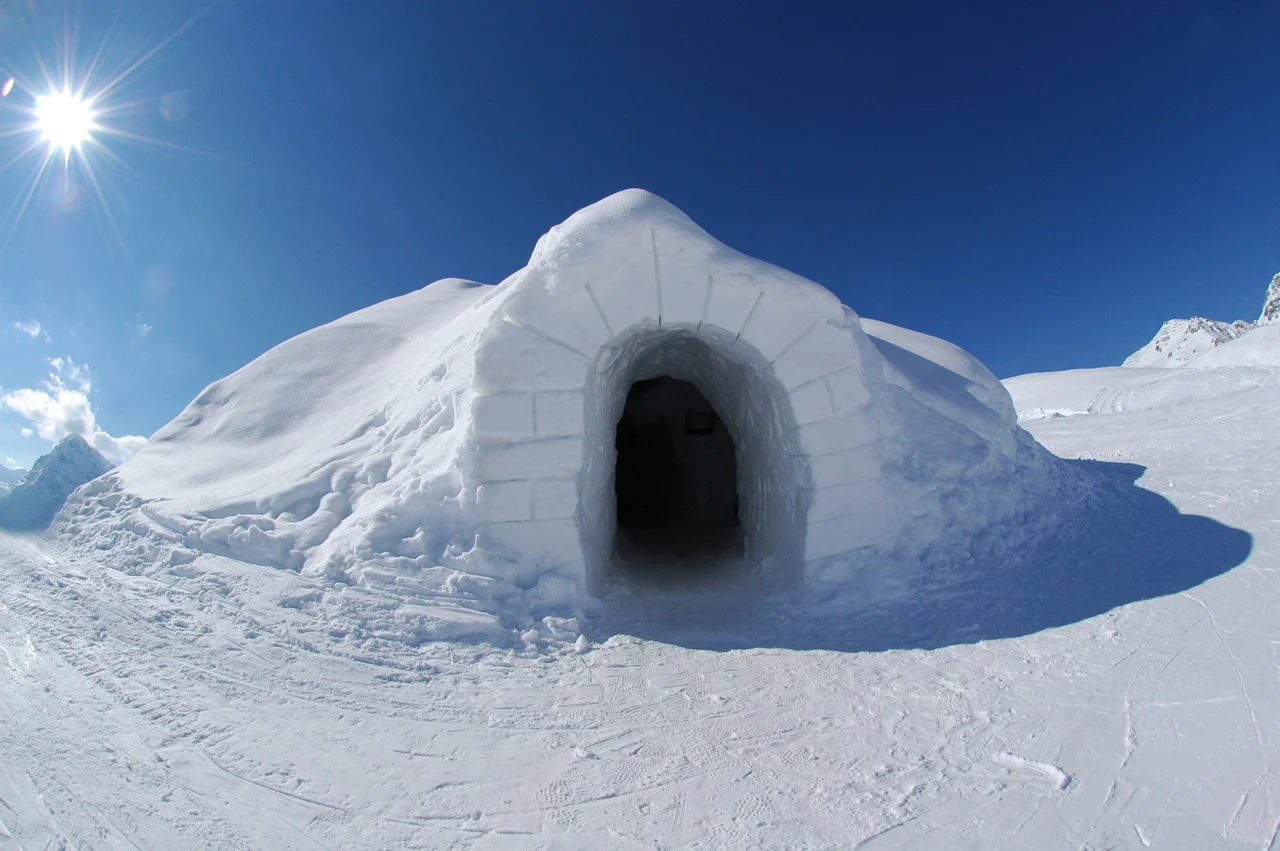
Iglu-Dorf Davos-Klosters
Davos, Switzerland
The village stands high on the Davos-Klosters mountainside, on a terrace above the treeline that is reached from the ski area rather than from a road. In summer the terrace is pasture and stone. In winter it is a broad, fairly level shelf of packed snow, and that shelf is the only ground the hotel ever has. The site is used again each season.
The building is snow. Domes are built up on the packed surface each winter from machine-made and shovelled snow, hollowed out, and finished inside as rooms and corridors. There is no foundation in the ordinary sense and nothing is dug into the terrace. The domes rest directly on the compacted snow layer, and the layer itself has to be prepared and left to settle before building starts.
A snow dome carries itself. The compacted snow behaves as an arch: the shell is thick at the base and thinner at the crown, and the weight runs down through the curve into the packed floor. Cold holds the whole thing together, so the interior is kept below freezing and the sleeping places are insulated mats and expedition bags rather than heated beds. When the season ends the domes are allowed to melt back into the terrace.
Ground that only exists in winter sets the calendar. The village cannot open until enough snow has fallen and been compacted, it cannot be extended once the thaw begins, and every room is new each year rather than inherited. It also means nothing is permanent on the terrace: services are brought in, and the site is expected to be returned to pasture in spring.
Sort this first: Which mountain site is open this season, how you reach it after the lifts stop, and what you sleep in.
Checked against published sources, September 2026
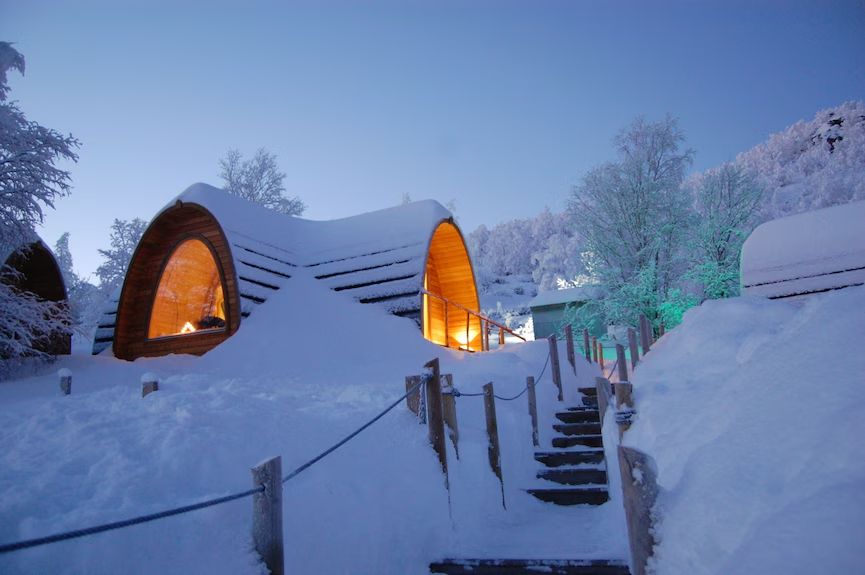
Kirkenes Snowhotel — Gamme Cabins
Kirkenes, Norway
Kirkenes sits at the head of a fjord in the far north-east of Norway, where the shoreline is worn bedrock with a thin cover of soil and heather. The cabins stand on that shore, a short distance from the snow hotel that gives the place its name. This entry is about the cabins, which are permanent buildings, and not about the snow structure beside them.
Each Gamme cabin is a small timber building set on the rock shelf above the water, with the fjord on one side and low scrub on the other. Where the shelf steps down, the cabins are levelled on short footings rather than by cutting the rock away, so the ground under them keeps its original shape. They are separate structures, spaced apart along the shore.
Bedrock is the simplest thing a northern building can stand on: it does not heave when it freezes and it does not settle when it thaws. That matters here, because the surface freezes hard every winter. The cabins are insulated, heated and serviced year round, which is what separates them from the snow structure nearby — that one is rebuilt each winter and gone by summer.
Solid rock lets the buildings stay small and stay put. Rather than one block, the site is a scatter of cabins following the shoreline, each one placed where the rock allowed it. Services run between them above or just below the surface, and the spacing means guests walk outside in the cold between the cabins and the main buildings.
Sort this first: Whether you have booked the permanent cabin or the snow room, and how the two are reached in winter.
Checked against published sources, September 2026
Arctic Bath
Harads, Sweden
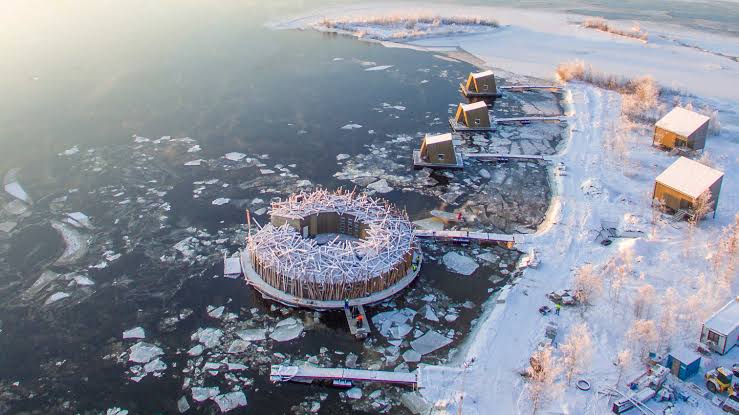
The Lule River runs past Harads in northern Sweden, wide and slow at this point, with a low forested bank. The main building is not on the bank at all. It is moored out on the water, reached by a walkway, so the ground under it is the river itself: open water in summer, and a solid sheet in winter.
The circular main structure rests on the water. It is a ring of rooms around an open cold bath, built to sit on the surface and held in position from the shore. When the river freezes, it is locked into the ice for the winter, sitting in the sheet rather than on top of it. Land cabins on the bank stand on ordinary footings and stay where they are.
For half the year buoyancy carries the building and the moorings only stop it drifting. For the other half the ice carries it, and the structure rises and falls with the river level as the sheet forms and breaks up. The design of the ring, and the way it is anchored, comes from that yearly change; the architects have published the principle.
Ground that turns from liquid to solid and back forces a building that can move. The walkway has to accept a changing level, the services have to tolerate the same, and the building cannot be extended outward the way a hotel on land can. It also fixes the character of the place: the cold bath is cut into the middle, open to the sky.
Sort this first: Whether the river is open or frozen when you arrive, and which of the water and land rooms you have.
Checked against published sources, September 2026
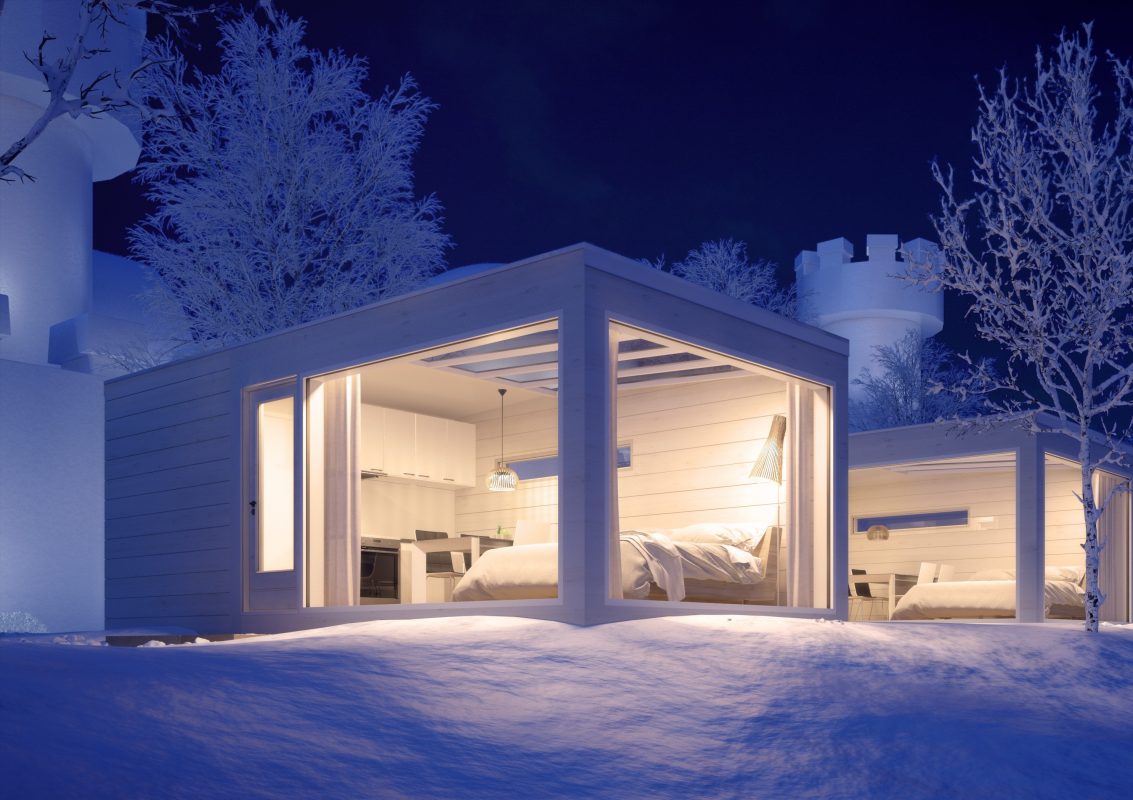
Seaside Glass Villas
Kemi, Finland
Kemi stands at the top of the Gulf of Bothnia, where the shoreline is low, sandy and almost flat, and the sea is shallow for a long way out. The villas are set on that shoreline, close to the water, facing south-west across the gulf. Behind them the ground rises so slightly that the difference is hard to see.
The villas are separate glass-fronted units placed along the beach line on prepared level ground, raised just clear of the shore so that the floors sit above the sand and the winter drift. They are permanent buildings with services run out to them, and they stand apart from the snow structures that the town builds elsewhere each winter. Each one is a separate unit rather than part of a row.
Low sandy shore is easy ground to build on and hard ground to build near. The units are kept light and small, spread along the beach rather than stacked, and each one is levelled on its own footings. Because the sea here freezes over each winter, the shoreline in front of them becomes a flat white plain rather than open water, and the buildings simply watch it happen.
Flat ground and a wide horizon are the whole point, so the villas are turned outward, with the glazed wall toward the gulf and the solid side toward the land. Nothing is built in front of them. The spacing along the shore keeps each unit's view clear, which is why the site reads as a line of buildings rather than a block.
Sort this first: Which way your villa faces, how far it stands from the water line, and how the shore is reached in winter.
Checked against published sources, September 2026
The other three chapters of the guide: Capsule Hotels · Casino Hotels · Art Hotels.